Short answer
Biohazard waste transport is built on containment science. Infectious material must stay sealed from the point of generation to a treatment facility, so packaging is designed to resist leaks and punctures, loads are segregated by hazard, and waste is treated by heat, steam, or other validated methods that inactivate pathogens. Every rule on bag size, labeling, and paperwork exists to prevent release along that route.
What makes waste biohazardous in the first place?
Waste becomes a biohazard when it contains, or may reasonably contain, microorganisms capable of causing disease. Blood-soaked materials, used sharps, cultures from laboratories, pathological tissue, and some items from isolation rooms are typical examples.
The concern is not the object itself but what might be living on or in it. Bacteria and viruses survive for different lengths of time outside the body, and some remain infectious long enough that a torn bag or a loose needle can expose a worker days later.
That is why transport rules focus on the pathway between the place waste is created and the place it is treated. The goal is simple: the organisms stay inside the container until a treatment process inactivates them. Everything else, from bag thickness to route planning, supports that goal.
Not everything from a cleanup or clinic qualifies. Packaging, clean gloves, paper towels used on dry surfaces, and general trash usually go out as ordinary waste. Separating the two at the source keeps the regulated stream smaller, safer, and less expensive to move.
Packaging in layers
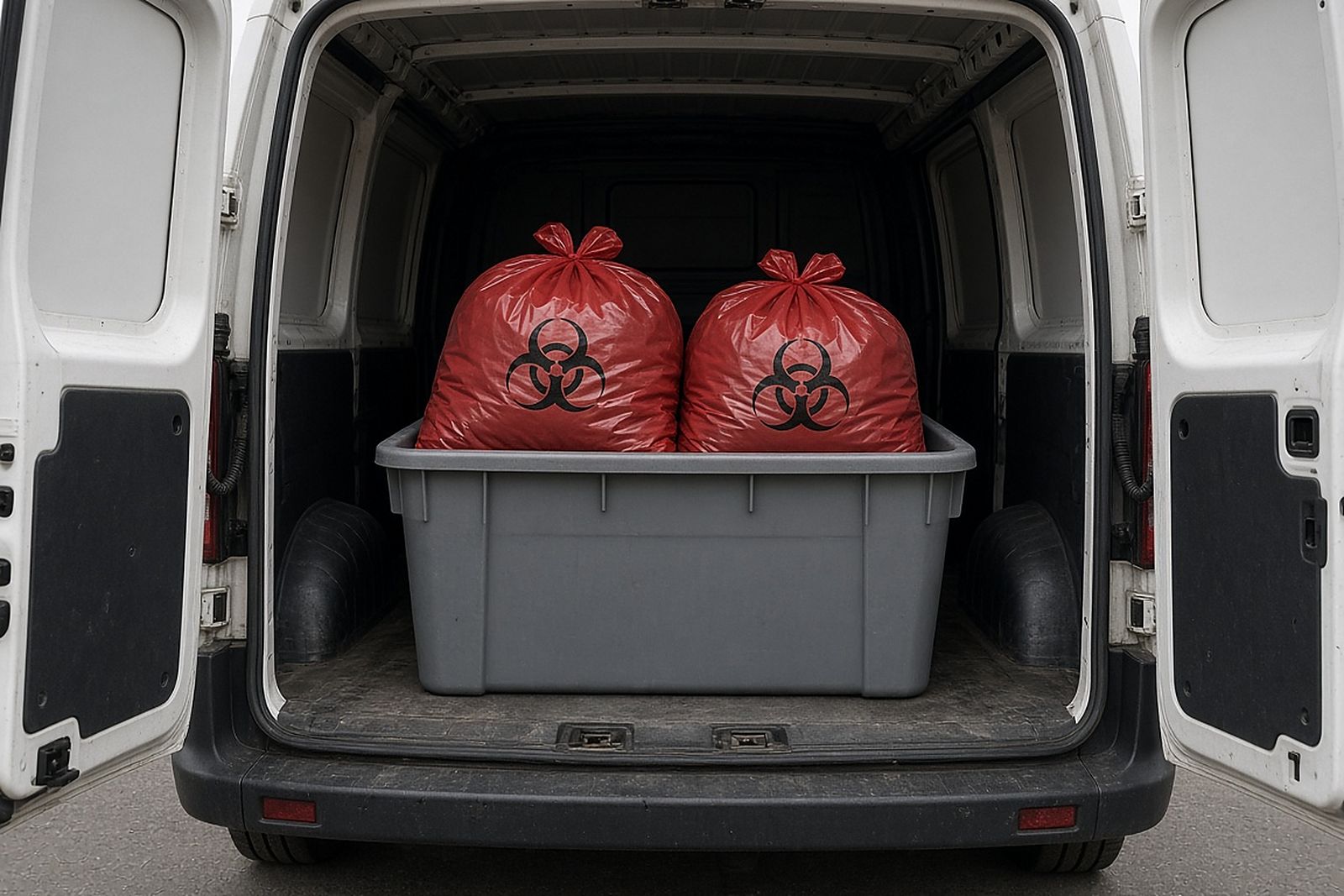
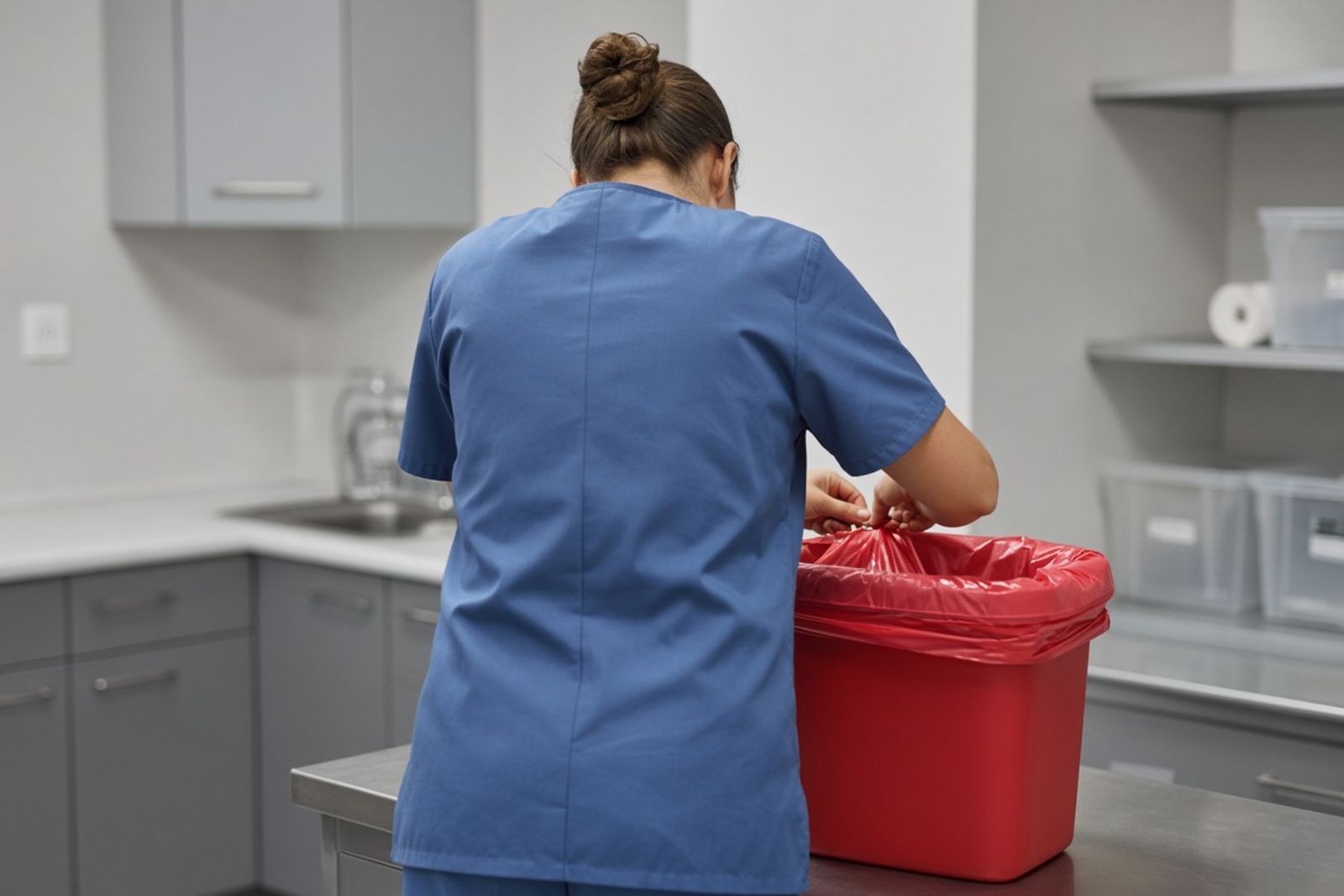
Packaging works in layers. A primary container, such as a red bag or a sharps container, holds the waste. That container goes into a rigid outer packaging, such as a corrugated box or a reusable cart, that protects it from crushing and impact during handling.
Each layer answers a physical risk. Plastic film resists liquid leaks but tears on sharp corners. Rigid boxes resist punctures and stacking loads but can soften if wet. Combining the two covers the weaknesses of each.
Weight, volume, and liquid limits
Weight and volume limits come from the same reasoning. Federal rules cap plastic film bags of solid regulated medical waste at 175 liters (46 gallons), and bags placed in carts or bulk packagings at 10 kg (22 lb) when filled, according to DOT PHMSA regulations published through Cornell's Legal Information Institute in 2024. A heavier bag is more likely to split when lifted or dropped, and a split bag defeats the whole system.
Liquid waste gets extra attention because it can flow through a small tear and spread widely. Absorbent material is often added inside packaging so that a leak is soaked up rather than pooled.
Why sharps get their own containers
Sharps combine two hazards: they carry infectious material, and they can inject it directly through skin. A bag can hold soiled gauze safely, but a single needle can pierce plastic film and the hand of whoever lifts it.
Sharps containers are designed to resist puncture from inside, to close permanently when full, and to stay upright during handling. Fill lines exist because overfilled containers force people to push waste down, which is exactly when needlesticks happen.
During transport, sharps containers ride inside outer packaging like any other regulated waste, but drivers and handlers are trained never to reach into boxes, compress bags by hand, or open closed containers. The design keeps human hands away from the points.
Sharps found during a cleanup rarely arrive in neat containers. Technicians pick them up with tongs or forceps, never with fingers, and place them point-first into a rigid container kept close to where they are working. Walking across a room holding a loose needle is exactly the kind of step the science tries to remove.
Why are some infectious substances classified more strictly?
Not all biological waste carries the same risk. Most medical waste from clinics and cleanup jobs falls into the regulated medical waste category. A smaller group of materials involves organisms that could cause permanent disability or life-threatening disease in otherwise healthy people after exposure.
Those higher-risk materials follow tighter rules. The American Bio Recovery Association, citing 49 CFR 173.134 in its 2023 state regulatory summary, notes that regulated medical waste containing a Category A infectious substance must be classed as an infectious substance and assigned UN2814, UN2900, or UN3549 rather than UN3291. The different identification numbers trigger stricter packaging, labeling, and handling.
For a typical homeowner or property manager, this distinction rarely comes up. Still, it explains why a transporter asks what the waste came from. The answer determines which rules apply before a single box is loaded.
The truck as a containment zone
A medical waste vehicle is designed as a moving containment zone. The cargo area is separated from the driver's compartment, has surfaces that can be cleaned and disinfected, and is loaded so that containers will not shift, tip, or crush one another in a sudden stop.
Spill kits ride on board because the science assumes things occasionally go wrong. Absorbents, disinfectant, protective equipment, and replacement packaging let a trained driver contain a leak before it spreads.
- Sealed, cleanable cargo surfaces that can be disinfected after each route
- Load securement that keeps boxes and carts upright
- Separation between the driver and the cargo compartment
- An onboard spill kit with absorbent, disinfectant, and spare packaging
- Placards or markings as required for the load
Heat, time, and a clean cargo area
Temperature matters too. Warmth speeds decomposition and odor, and it can soften cardboard over time. Transporters plan routes and storage times to limit how long waste sits before treatment, and some use refrigerated units where storage would otherwise run long.
Cleaning the truck is part of the cycle. After unloading, the cargo area is inspected for leaks or residue and disinfected as needed, so the next route does not start with contamination left over from the last one.
Treatment at the end of the route
Transport ends at a treatment facility, where the organisms are inactivated. Historically, burning was the main method, and other methods have since taken on a much larger share.
Autoclaving uses pressurized steam to raise the waste to a temperature high enough, for long enough, to kill microorganisms. Facilities often shred the waste first so steam penetrates evenly. Chemical and microwave systems use different mechanisms but follow the same principle of validated time, temperature, or concentration.
Validation is the key scientific idea. Treatment facilities regularly test their equipment with biological indicators, which are strips or vials of highly resistant spores. If those spores do not survive, the process is working. After treatment, most waste can go to a landfill as ordinary solid waste, though pathological waste and some pharmaceuticals follow different routes.
After a cleanup: the science in sequence
The same principles run through every remediation job. A crew finishing a bedroom after an unattended death may be left with a section of carpet and pad, a mattress, pieces of drywall, used protective equipment, and sometimes used syringes found in a drawer.
Soft waste goes into red bags without overfilling, syringes into a rigid sharps container, and everything into approved boxes with absorbent where material is damp. Each box is taped, labeled, and staged in a secure area away from foot traffic.
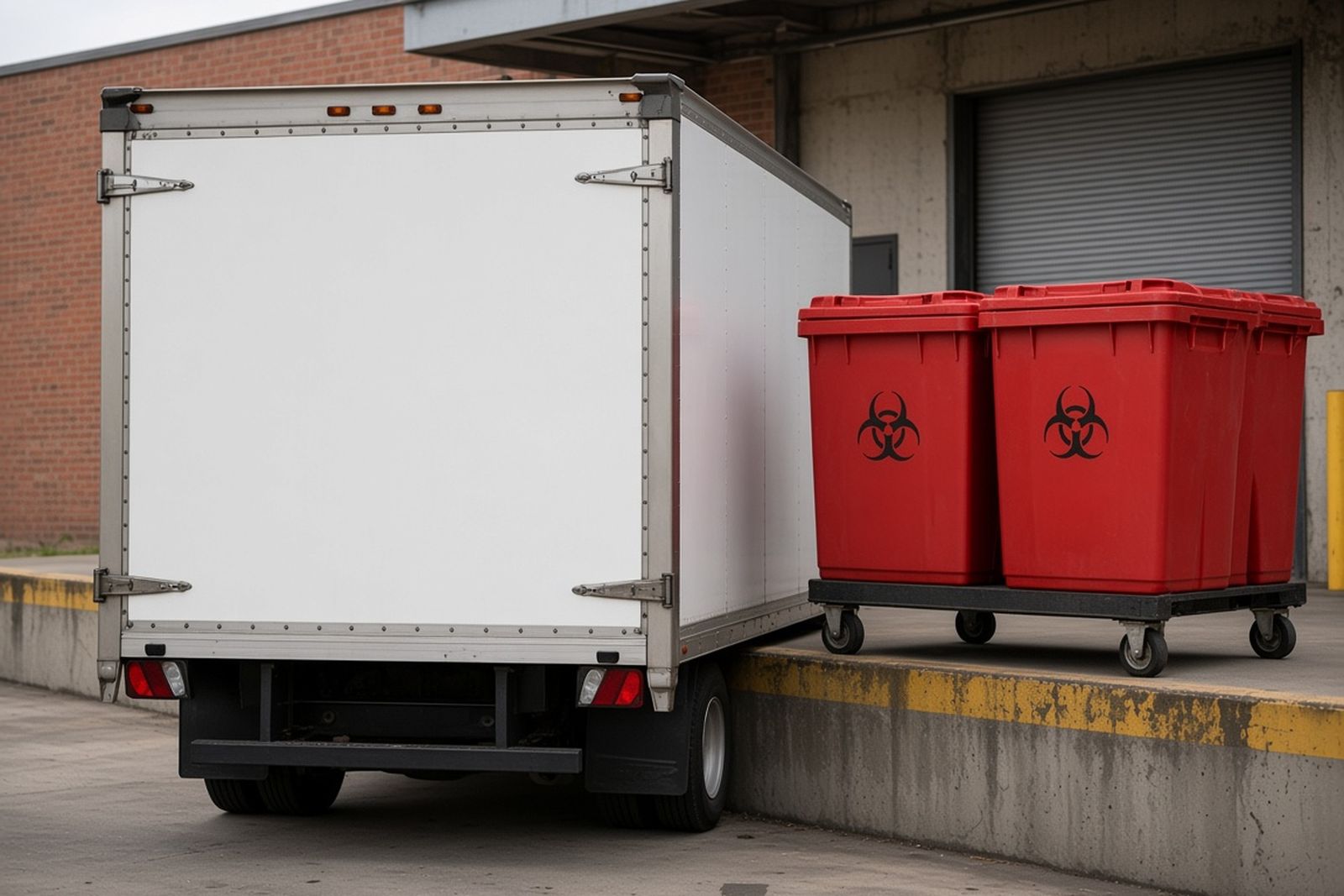
At pickup, the driver checks that boxes are sealed and dry on the outside, signs the manifest with the crew lead, loads the boxes so they cannot shift, and drives them to a treatment facility. The property owner or manager can receive a copy of the tracking document showing where the waste went and when.
Why does paperwork matter if the waste is sealed?
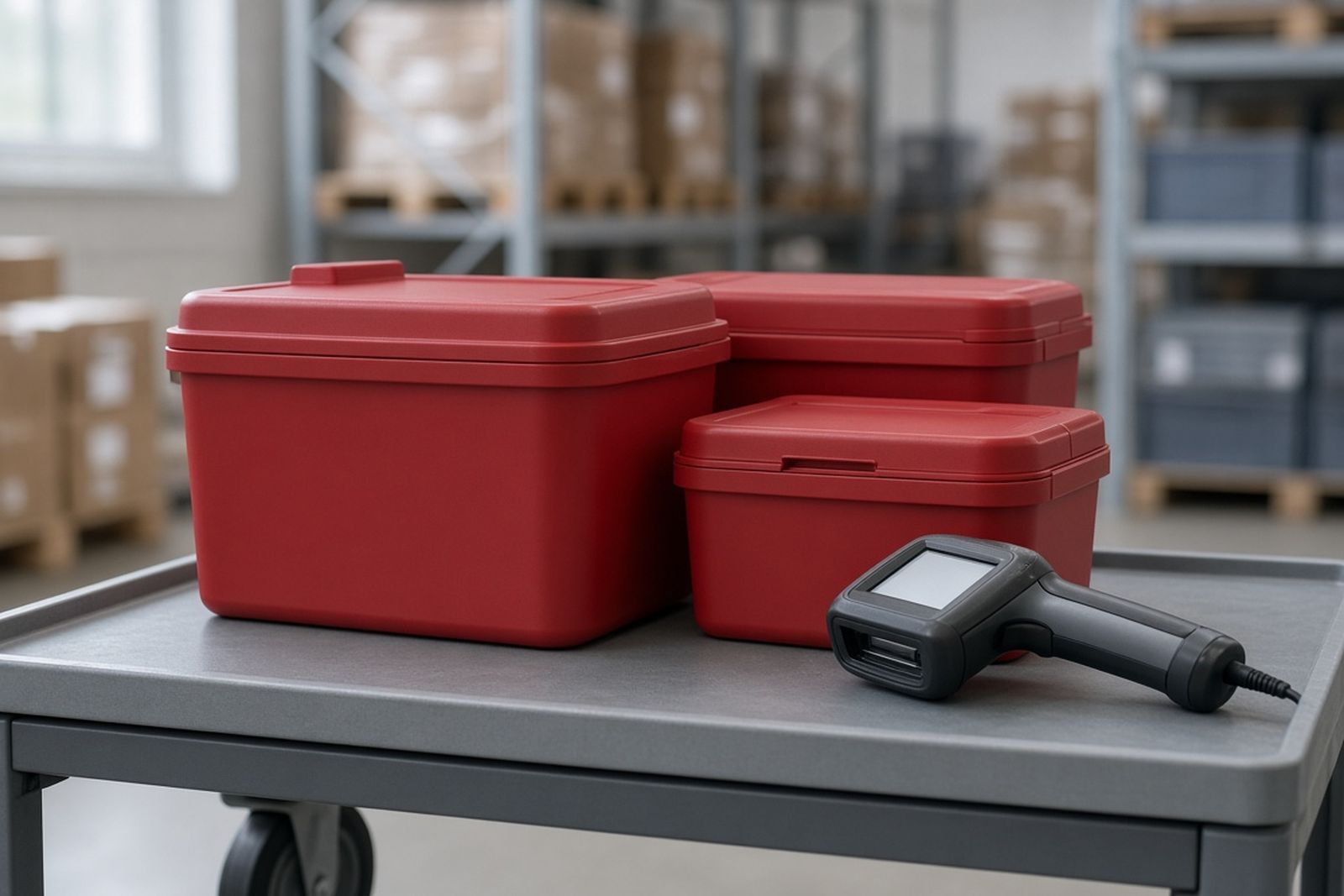
A manifest or tracking form is the scientific chain of custody. It records who generated the waste, what type it is, how much there is, who carried it, and who treated it. If a container leaks or goes missing, that record shows exactly where to look.
Paperwork also protects you. If you are the generator, you may carry responsibility for the waste until it is properly treated, depending on your state. A signed record from the treatment facility is your proof that the waste reached its destination.
Federal medical waste tracking rules expired decades ago, so most requirements now come from states. Ask your transporter which forms it will provide for your jurisdiction, and check with your state medical waste program if anything is unclear.
What to take away from the science
Every step in biohazard waste transport answers a specific failure point: leaks, punctures, crushing, heat, delay, or loss. When a transporter insists on sealed boxes, refuses an overfilled bag, or asks detailed questions about the source, they are applying that science.
Those questions are not red tape. A transporter who knows the source can choose the right packaging, estimate weight accurately, and route the load to a facility permitted to accept it. A transporter who asks nothing is guessing, and guesses are where containment failures begin.
If you ever find yourself holding waste you are not sure how to handle, do not compress it, open it, or put it in household trash. Keep people and pets away, and call a licensed provider who can package and move it correctly.